
Steven Seidenberg
Photography of Absence and the Afterlives of Space
by Alexa Bouhelier-Ruelle
There is a stillness in Steven Seidenberg’s work that resists immediate understanding. His photographs do not seek spectacle; instead, they linger in the margins—on the edges of what is seen, remembered, and often overlooked. Empty interiors, abandoned structures, and fragments of lived spaces become the subjects of a practice that is less about documentation and more about perception itself.
What draws him to these places is not their obvious narrative, but their potential to disrupt it. For Seidenberg, photography begins in a subtle tension between image and viewer, one that challenges the familiar and reframes what we think we see. “One of the challenges is the creation of the tension that transports the viewer from the lethargy of normative perception into the novelty of focus,” he explains. His images operate within that threshold—where recognition gives way to uncertainty, and where attention becomes an act of discovery.
%2C%20The%20Architecture%20of%20Silence.jpg)
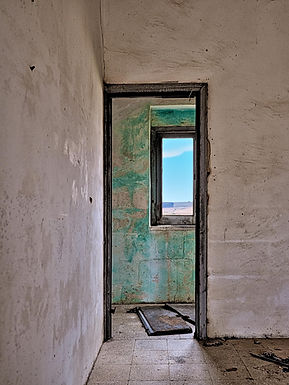
Across his series, from Italy to Rome to Japan, geography becomes secondary to something more elusive. What connects these spaces is not culture in the traditional sense, but a shared fragility—an impermanence embedded in both place and memory. “What unifies the bodies of work is precisely the evanescence of the notion of home,” he says. In his photographs, “home” is never fixed; it shifts, dissolves, and re-emerges as something both intimate and unstable.
Absence, in Seidenberg’s work, is not emptiness—it is presence reframed. Rooms without inhabitants, traces without bodies, spaces suspended between past and future all carry a quiet weight. “Presenting absence as itself a kind of presence in the frame,” he notes, is central to his practice. The photograph becomes a site of transformation, where time lingers and where disappearance is not erased, but held within the image itself.
This approach extends to his deliberate avoidance of photographing people. Instead, he focuses on what remains—the objects, marks, and environments that bear witness to human life. “The only way to photographically imagine lives is by imaging the traces of having lived,” he explains. It is through these traces that viewers are invited in—not as observers of others, but as participants, projecting their own memory and experience into the frame.
“The unseen and unremembered is one of the only paths to understanding the broader system.”
There is, too, a political dimension to this quiet observation. By focusing on the overlooked—the material details of everyday life—Seidenberg reveals the broader systems that shape them. The spaces he photographs, whether migrant encampments or abandoned rural houses, carry the imprint of social and historical forces. “The unseen and unremembered is one of the only paths to understanding the broader system,” he reflects. In this way, his work resists erasure, insisting on the visibility of what is often excluded from dominant narratives.
And yet, despite the weight of these themes, there is a certain poetry that runs through his images. A softness in decay, a rhythm in repetition, a sense of quiet contemplation. For Seidenberg, this multiplicity is essential. “A series can be understood as documenting while also making strident political or aesthetic claims,” he says. Photography, like writing, becomes a space where meanings overlap, where form and feeling coexist.
Ultimately, his work leaves us with a question rather than an answer. It asks us to reconsider the spaces we move through daily—the histories, futures, and invisible tensions. “Every site is a site of future abandonment,” he reminds us, “just as every action affects an ever-expanding set of material consequences.”
In Seidenberg’s world, nothing is static. Every space holds its past, its present, and its eventual disappearance all at once. And perhaps that is where his work resonates most deeply—in the quiet recognition that the places we inhabit are never truly fixed, but always in the process of becoming something else.


Words by Alexa Bouhelier-Ruelle
Photos provided by Artist
