
Kanoko Inoue
A Space Where Coffee Becomes Conversation
by Lisa Wallin
In Toyama, a coastal city along the Sea of Japan about two hours from Tokyo by the Hokuriku Shinkansen, Sixth or Third Coffee Stand sits within the grounds of Honganji Toyama Betsuin, a branch temple of the Jodo Shinshu Buddhist sect. The café occupies one unit in a nagaya-style row of small storefronts attached to the temple complex in the Sogawa district, third from one end and sixth from the other, a detail that gave the café its name. Since opening in 2018, owner Kanoko Inoue has shaped the space into a relaxed meeting point for locals, passersby, and travelers.
If the café were a single work of art, she imagines it as something that changes from day to day. “Sixth or Third Coffee Stand is like a live show,” Inoue says. “The conversations and music are always different depending on who comes in.”
“That slight irregularity creates space where conversations and unexpected moments can enter.”
For Inoue, making something—whether a cup of coffee or a piece of visual work—comes from the same place. “Brewing coffee, drawing, and designing all help expand my imagination,” she says. “When I’m creating, I can immerse myself completely. It’s a time when discoveries appear and when I begin to see what I might want to try next.”
The process only gains meaning, she adds, when it connects with others. Knowing that someone enjoys what she has made becomes the motivation to keep creating.
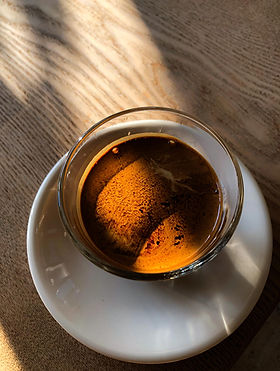
At the center of the café stands the counter that defines the space. Positioned in the middle of the room, it allows visitors to experience the preparation of coffee up close—from the aroma of freshly ground beans to the quiet rhythm of pouring.
“The counter is almost the face of the shop,” Inoue explains. “Because it’s in the middle, customers can experience the entire process until the cup is served.”
That closeness subtly changes how coffee is experienced. Preparing and serving it becomes something closer to a shared moment than a simple transaction.

Inoue often approaches illustration and design by imagining a space first. When searching for direction, she pictures a room—its colors, atmosphere, and small details—and translates those impressions into visual form.
“I sometimes picture a favorite kind of space,” she says. “I think about what colours might exist there and what kind of text might appear in it. From that, I start to find the direction I want to draw.”
For her, shaping a physical environment and creating visual work follow similar instincts.


That sensibility appears clearly inside Sixth or Third Coffee Stand. Rather than filling the room with decoration, Inoue focused on the balance of simple elements. The walls appear white but carry a faint gray tone, while soft incandescent lighting warms the room. Worn wood surfaces meet exposed metal piping, creating a quiet backdrop that allows small details—coffee beans, baked sweets, handmade ceramics—to stand out naturally.
Equally important is what she chooses not to fill. Leaving breathing room within the space allows for what she describes as a gentle unevenness. “That slight irregularity creates space where conversations and unexpected moments can enter.”
Those moments often begin with the rhythm of the surrounding neighborhood. The café sits among restaurants and small shops, creating a steady flow of visitors. Some stop in during a shopping trip or while walking their dogs, while others arrive after eating soba nearby. The café also collaborates with neighbouring businesses, including a folk craft shop where exhibitions have been organized together.
Visitors from overseas frequently wander in as well. “When I talk with visitors from abroad, it sometimes feels like taking a small trip,” Inoue says. Conversations with customers often spark unexpected ideas, influencing the music she chooses, the goods the café produces, and occasionally the menu.
Looking ahead, Inoue hopes to continue expanding the creative connections that have grown around the café. Collaborations with artists have already led to original items such as mugs and tote bags, and she hopes to eventually open an online shop so more people can experience the café’s coffee and goods beyond Toyama.
For now, Inoue is content letting the café unfold day by day—each conversation and each cup adding something new to the scene.


Words by Lisa Wallin
Photos provided by Kanoko Inoue
